

The MSP Loyalty Paradox: Why Satisfied Clients Are Still Shopping Around
To Bring Impactful Value to every life we touch and serve in the community.
LBT TECHNOLOGY GROUP, LLC, 2015
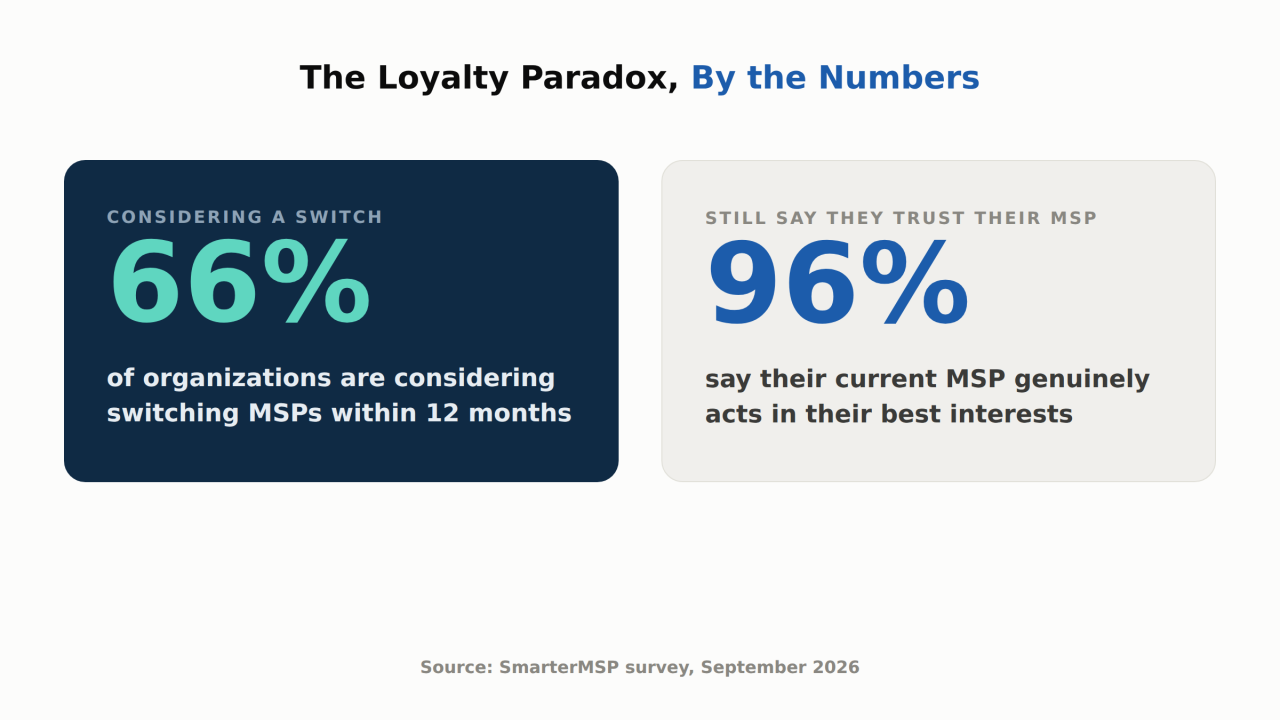
So which is it? Are businesses happy with their IT partners, or are they halfway out the door?
The honest answer is both — and understanding why is one of the more useful things a business owner or operations leader can do this year, whether you're evaluating a new MSP relationship or trying to figure out if your current one is still the right fit.
It's Not About Today. It's About Tomorrow.
The instinct is to read "two-thirds of clients are considering a switch" as a satisfaction problem. It isn't, at least not in the traditional sense. Nobody is saying their MSP dropped the ball on a support ticket or missed an SLA. What they're saying, in effect, is: I trust you with what I need today, but I'm not convinced you're the partner I'll need in two years.
That's a meaningfully different problem, and it's a newer one. For most of the last decade, MSP relationships were judged on a fairly narrow set of criteria: Do things stay up? Does the help desk answer the phone? Is our data backed up? Those questions still matter, and the survey confirms most businesses believe their current provider handles them well.
But a new set of expectations has stacked on top of the old ones, and they center on two things: how ready a provider is to help a client actually use AI, and how well a provider can knit together the sprawling mess of systems, platforms, and tools that make up a modern business's technology stack. Providers who haven't visibly evolved to meet those expectations are getting quietly re-evaluated — even by clients who would otherwise give them a glowing reference.
The Six Reasons Clients Start Looking Elsewhere
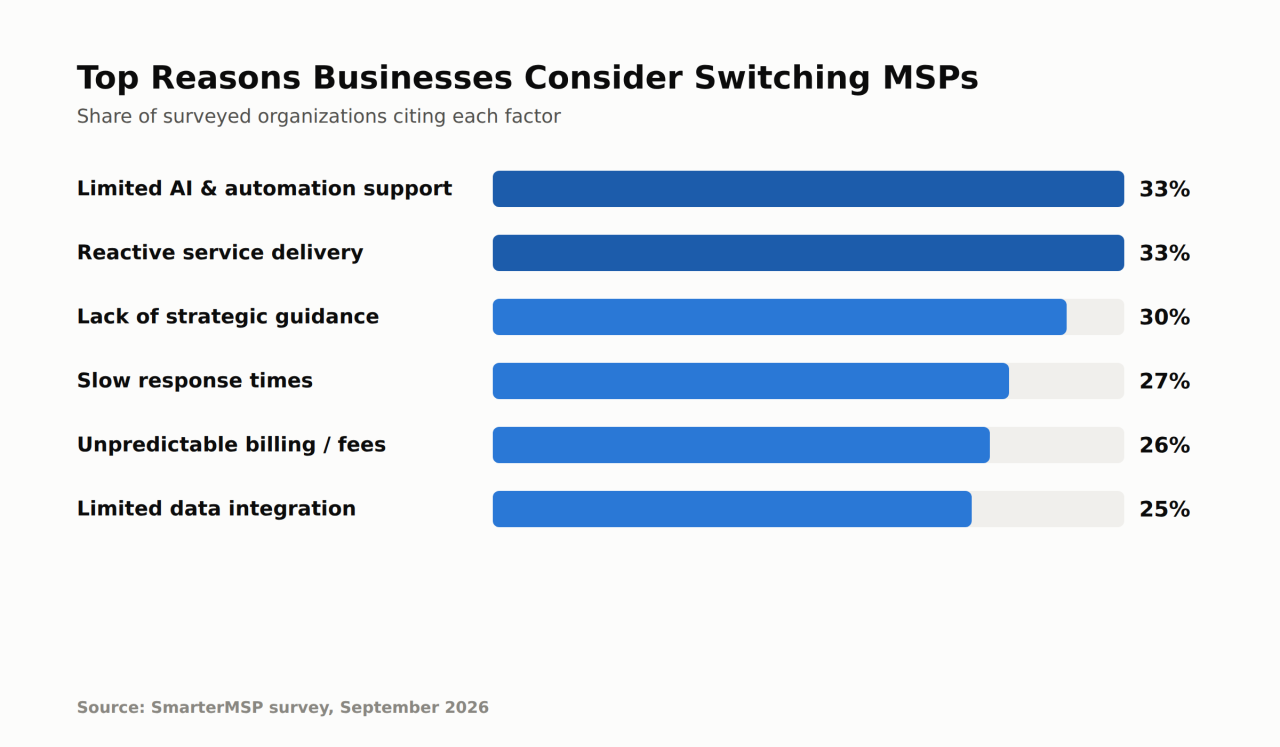
When the survey asked organizations what's actually driving them to consider a change, six reasons rose to the top, and they cluster into a pattern worth paying attention to:
Limited AI and automation support (33%). This tied for the single biggest reason clients give for shopping around. Businesses don't necessarily expect their MSP to have every answer about AI, but they do expect a provider who can speak intelligently about it, help separate real opportunity from hype, and put guardrails around the risk — rather than staying silent and hoping the topic doesn't come up in the next contract renewal.
Reactive service delivery (33%, tied for first). Clients have gotten used to "we'll fix it when it breaks," and increasingly they don't want it anymore. The bar has moved to proactive monitoring, predictive maintenance, and a provider who flags a problem before it becomes an outage.
Lack of strategic guidance (30%). This is the difference between a vendor who takes tickets and a partner who helps set technology direction. Clients increasingly want a seat at the planning table, not just a phone number for when something's broken.
Slow response times and support delays (27%). The fundamentals still matter. No amount of strategic vision compensates for a help desk that takes too long to pick up.
Unpredictable billing and unexpected fees (26%). Surprise invoices erode trust fast, particularly for finance and operations leaders who are accountable for budget predictability.
Limited data integration across systems (25%). The newest entrant on this list, and arguably the most telling. More on this below.
Notice what's not driving most of the switching consideration: outright security failures, catastrophic outages, or blown SLAs. Those still happen and still matter, but the survey suggests the more common trigger is forward-looking — a sense that the relationship isn't built for where the client is headed.
What Businesses Actually Want From an MSP Now
The flip side of "why clients leave" is "what clients are prioritizing," and the survey's findings there are consistent with the switching data. When asked what they most want their MSP to prioritize, respondents pointed to:
- •Cybersecurity operations — 36%
- •Risk reduction — 36%
- •Data integration across tools — 35%
- •AI readiness and enablement — 33%
Security and risk management remain the anchor of the relationship, which tracks with everything most MSPs have built their businesses around for years. But data integration and AI readiness are now essentially tied with security in terms of how much clients care about them — and those are areas where a lot of providers, frankly, haven't built out a clear story yet.
The Data Integration Blind Spot
Of everything in the survey, the data integration finding deserves the most attention, because it's the one most businesses haven't thought to ask their MSP about directly.
Nearly every organization surveyed said that integrating data across security tools, infrastructure, cloud platforms, and core business systems matters to them. More than a third said they expect their technology partner to either directly own that integration work or provide strong, hands-on support for it.
Think about what that actually means in a typical mid-sized business. Your security stack generates alerts. Your cloud platforms generate usage and cost data. Your line-of-business systems — accounting, CRM, practice management, EHR, whatever runs your operation — generate records that matter for compliance and decision-making. When those systems don't talk to each other, you end up with blind spots: a security alert that never gets correlated with an unusual login pattern in your CRM, a compliance report that has to be assembled by hand because nothing exports cleanly, a leadership team making decisions on partial information because nobody integrated the dashboards.
This is also the foundation AI readiness sits on, whether providers say so explicitly or not. AI and automation tools are only as useful as the data they can actually reach. A business with disconnected systems and manual data handoffs isn't in a position to meaningfully use AI for much of anything, regardless of how much a vendor talks about it in a sales pitch. Data integration is the unglamorous prerequisite that makes the flashier AI conversation possible.
What This Means If You're Evaluating Your Own MSP Relationship
If you read the six reasons for switching and the four top priorities above and found yourself nodding along, it's worth using this as a prompt to ask your current provider — or any provider you're considering — some direct questions:
- •What does your roadmap look like for AI and automation, and what has changed about your service in the last 12 months to reflect it?
- •Can you show me, concretely, how you're monitoring and catching issues before they affect us — not just how quickly you respond after something breaks?
- •Who owns the work of connecting our security tools, cloud platforms, and business systems so we get a unified view, and what does that actually look like in practice?
- •Beyond the technical work, who is helping us think ahead — reviewing risk, planning budget, and adjusting strategy as our business and the threat landscape change?
- •Is our billing structured so we can predict costs, and can you explain any fee before it shows up on an invoice?
None of these are trick questions, and a strong provider should be able to answer them clearly and specifically, with real examples rather than marketing language. If the answers are vague, generic, or the conversation quietly steers back to uptime and ticket counts, that's useful information too.
Trust Is the Floor, Not the Finish Line
The most important thing this survey gets right is naming a paradox a lot of businesses are quietly feeling but haven't articulated: it's entirely possible to trust your MSP and still worry they're not the right long-term partner. Those aren't contradictory positions. Trust is what keeps a relationship intact today. Vision — a clear, demonstrated plan for cybersecurity risk management, data integration, and AI readiness — is what determines whether that relationship still makes sense two or three years from now.
At LBT Technology Group, this is the thinking behind why we built our Layered Risk & Support framework around more than uptime and help desk tickets. Cybersecurity risk management, compliance, data integration, and forward-looking strategic guidance through our vCIO services aren't add-ons we're bolting on because a survey said clients want them — they're the reason the framework exists in the first place. Proactive risk reduction and a clear-eyed plan for where AI actually helps (and where it introduces new risk) only work when they're built into the relationship from day one, not retrofitted after a renewal conversation gets uncomfortable.
If this survey's findings sound familiar — if you trust your current provider but can't quite picture where they're taking you next — that's worth a real conversation, not a snap decision. Whether that conversation is with your current MSP or a new one, ask the direct questions above and pay close attention to how specifically they're answered.